Fast-paced content is often described in simple terms: events that last minutes rather than hours, quicker betting cycles, and round-the-clock availability. In most cases, a match is settled in around 10 minutes or less, which makes the format particularly appealing to users looking for a faster outcome and a shorter wait. That is all true, but it does not fully explain why the format has become such an important part of the modern sportsbook mix or why it appears to resonate particularly strongly in LatAm.
The real value of fast-paced content lies not simply in shorter events but in a different engagement model. Built around immediacy, repeated live interaction, and faster decision-making, it creates a very different user journey from traditional sports betting.
To explore this more closely, we reviewed cross-regional performance data from BETER’s esports content available at several sportsbook brands operating both in LatAm and Europe between December 2025 and March 2026. The analysis focuses on ESportsBattle, exclusively distributed eLeagues content by BETER and provided with live streams, real-time data and odds. BETER delivers more than 500,000 events annually through ESportsBattle, including such popular disciplines as eFootball, eBasketball, eHockey, and eTennis. The findings discussed here relate specifically to some of these titles and their modes. Rather than making broad claims about the market as a whole, the goal was to identify recurring behavioural patterns across regions.
Fast-paced content is overwhelmingly live-led rather than prematch-led
One of the clearest takeaways from the data reviewed across both LatAm and Europe is that fast-paced content is, above all, a live product. Across the key disciplines analysed, the overwhelming majority of turnover comes from live betting rather than prematch activity. That matters because it defines the category at a structural level: the value of fast-paced content lies in immediacy, repeated in-play interaction, and shorter decision cycles rather than in long prematch build-up.
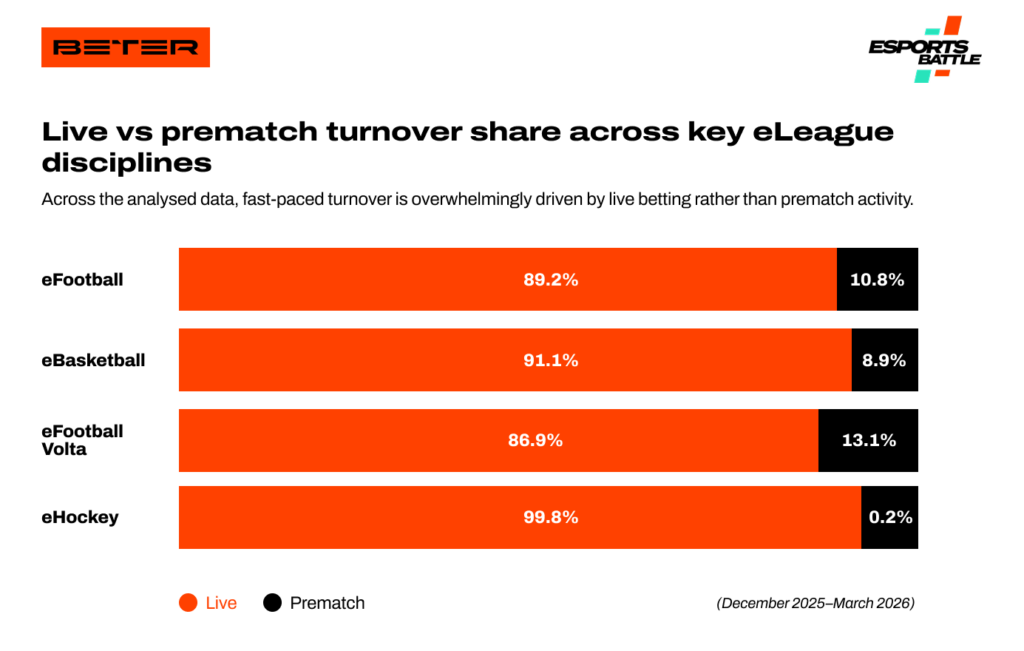
This is where the category begins to structurally separate itself from traditional sports betting. In classic betting environments, the user journey is often built around anticipation: team news, prematch analysis, line movement, and then in-play. Fast-paced content begins much closer to the point of action. It is designed around continuous interaction and repeated micro-decisions rather than long-form event narratives.
Looking specifically at ESportsBattle data for the aforementioned period, familiarity still plays a decisive role even in this faster environment. Across the three disciplines reviewed — eFootball (and eFootball Volta), eBasketball, and eHockey — eFootball remains the anchor discipline in both LatAm and Europe. That underlines an important point: even when the format changes, users still gravitate towards betting experiences built around recognisable sports logic. Football remains the strongest cultural reference point across much of the betting landscape, and fast-paced formats clearly benefit from that familiarity.
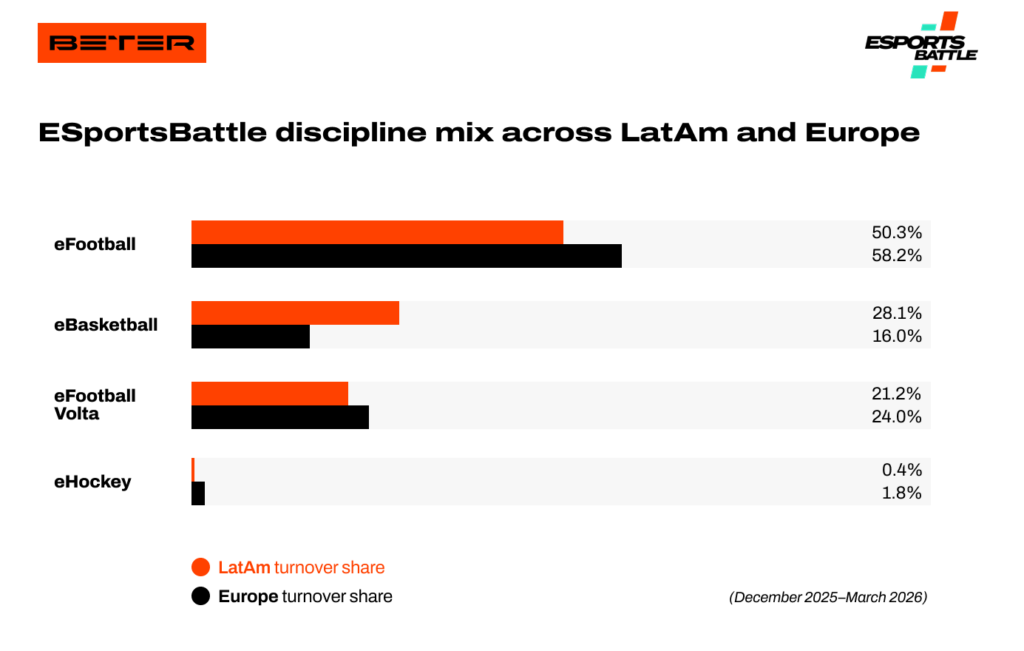
The clearest differences emerge once the mix moves beyond eFootball. In LatAm, eBasketball accounts for a much larger share of turnover than in Europe, pointing to a broader mix beyond football-led formats. Europe, by contrast, shows a slightly stronger concentration around football and a clearly stronger position for eHockey, which is hardly surprising given the sport’s deeper cultural presence there.
LatAm users are not behaving exactly like European ones
The most interesting part of the picture is not only which disciplines perform best, but how users engage with them.
The data also points to two different bettor profiles. In Europe, fast-paced content appears to attract a higher-value pattern overall, with stronger bettor value and larger average stakes. In LatAm, the format looks more engagement-led, with users interacting more actively within the same event.
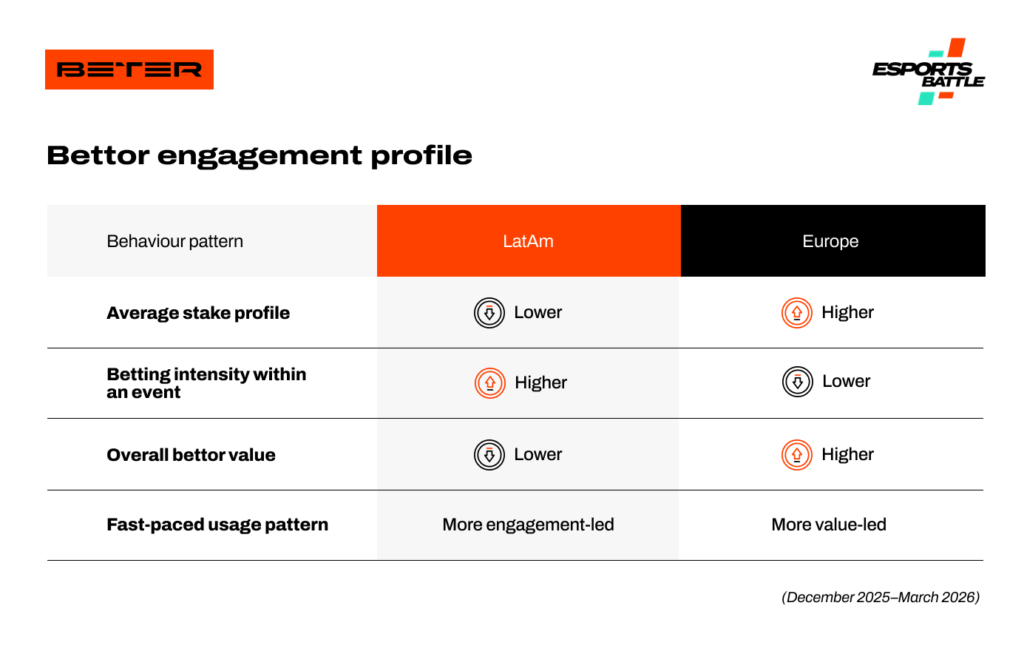
That does not mean one market is simply “better” than the other. It means the same product may serve different functions depending on where it sits in the sportsbook mix.
It would be too simplistic to explain that difference through economics alone, but purchasing power, market maturity and staking habits are all likely to play a role. More importantly, from a product perspective, it suggests that the same fast-paced discipline will not necessarily be used in the same way in every region.
This is where the market-level detail becomes more interesting. Another striking pattern concerns the types of markets users prefer within already short-cycle formats. Fast-paced content is, by definition, built around shorter betting cycles. Part of the LatAm performance data appears to push that logic even further, favouring markets that can settle more quickly within the event itself.
This is especially visible in selected shorter-resolution markets. In the data reviewed, LatAm shows a consistently higher turnover share than Europe in markets such as the 1st half total in eFootball and eBasketball, as well as the 1st half 1×2 in eFootball Volta. For part of the LatAm audience, the appeal seems to lie not only in shorter events, but also in markets that shorten the wait for an outcome even further.
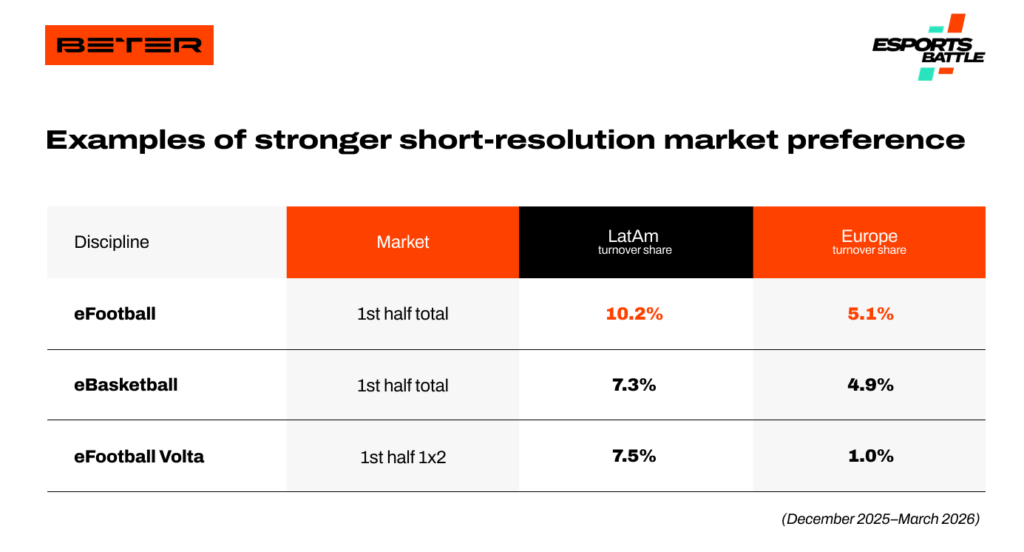
That matters because it adds another layer to how operators should think about fast-paced content. The opportunity is not only to offer shorter events, but to understand how different audiences engage with outcome speed inside those events. In that sense, market preference is shaped not only by geography, but also by discipline — which is why a one-size-fits-all approach is rarely the right one.
Fast-paced content in LatAm is also a continuity product
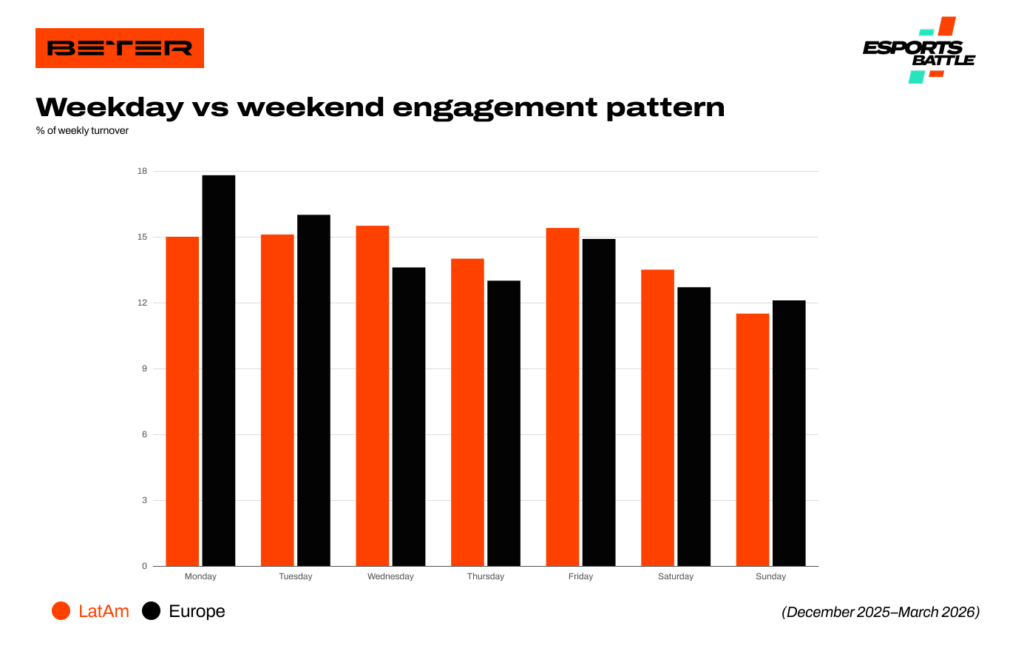
Day-of-week patterns point to another important role for fast-paced content: continuity. The format does not just add volume — it helps sustain engagement beyond marquee sports peaks.
In the analysed cross-regional data, activity in both LatAm and Europe is stronger during the working week than at the weekend. That is especially interesting because it runs against the usual pattern associated with traditional sports betting, where marquee weekend fixtures often dominate attention. In fast-paced content, weekday relevance appears much stronger.
That makes strategic sense. At weekends, the sportsbook is crowded with live traditional sports, particularly football. During the week, by contrast, fast-paced content has more room to act as a continuity product — something that helps sustain engagement when there are fewer major fixtures competing for attention. From an operator perspective, that is one of the category’s most important strengths: it does not only perform around major sports peaks, but can also help bridge the quieter periods between them.
Winning the LatAm Rhythm
In LatAm, fast-paced content has ceased to be a filler product. Its success is no longer a question of volume, but of strategic alignment. Its real value depends on its fit with sports familiarity, market preference, and live betting habits, while serving as a consistent weekday engagement layer.
In LatAm, that synergy appears especially strong. The market demands a product that is live, familiar, engagement-driven, and geared toward faster in-event resolution.
To win, operators must move beyond “always-on” availability and align with the region’s specific logic: a mix of live interaction, familiar sports frameworks, and a craving for instant results. The real opportunity for growth in the region isn’t just about offering more content; it’s about delivering the right fast-paced content, tailored to the specific rhythm of the LatAm bettor.
The exclusive analysis was originally published on Gaming Intelligence Español.