A previous Gaming Intelligence Español analysis of fast-paced content in LatAm showed that the region is not only open to this type of content, but actively engages with it across esports and sports formats. That is an important commercial signal for operators. But performance is only the first part of the discussion.
The next question is whether this content can be integrated, documented, governed, and scaled in a way that meets regulatory expectations.
This is where legal readiness becomes part of the product’s value.
Performance needs a regulatory foundation
Sportsbooks and aggregators are not simply adding new content to fill gaps in the schedule. They are adding products that must pass internal compliance review, fit local regulatory frameworks, satisfy partner due diligence, and remain reliable after launch. In maturing markets, content performance and regulatory readiness can no longer be treated as separate topics.
For fast-paced content, this is especially important.
High-frequency content operates differently from traditional sports. It involves a larger number of events, continuous schedules, live data, streams, odds, fast settlement, and ongoing integrity monitoring. These characteristics create value for operators because they support continuous sportsbook engagement. But they also create a more demanding legal and operational environment.
BETER delivers more than 50,000 esports and sports events each month, and over 700,000 events annually. At this scale, legal readiness cannot be an afterthought. The product must be explainable, documented, monitored, and supported by clear governance.
Before launch, operators and aggregators need to understand what exactly they are integrating. How is the product classified? What rules apply to the event format? How is the data collected and delivered? What integrity controls are in place? Who is responsible for what under the contract? What documentation can be shared with internal compliance teams and, where required, with regulators?
These questions are not theoretical. They can affect whether a launch moves quickly or gets delayed.
Regulator-ready content reduces launch friction
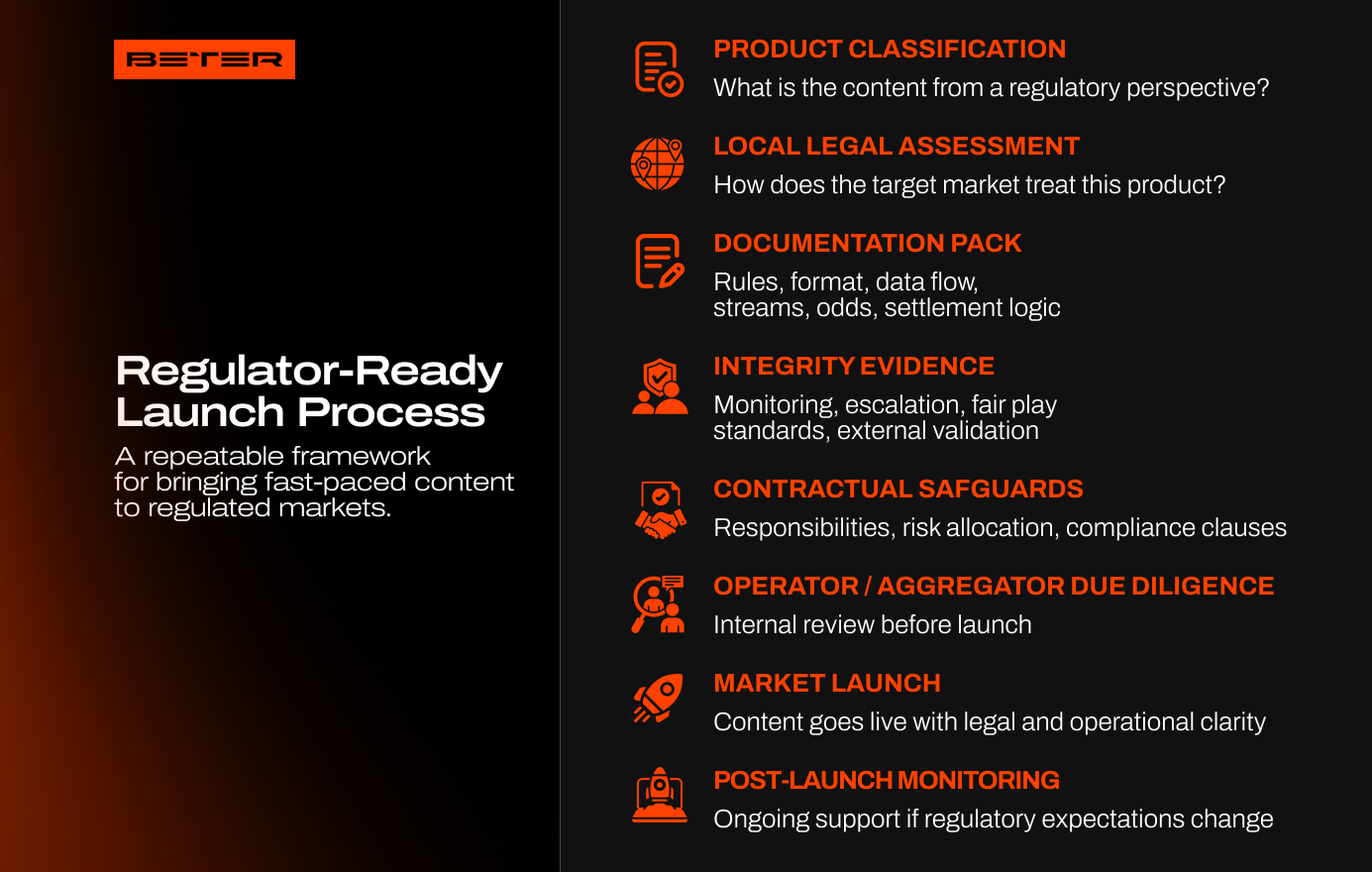
In regulated markets, a strong content provider is not only the one that offers volume, margin potential, or attractive formats. It is the one that can support the operator through the entire route to market: product explanation, legal assessment, documentation, contractual clarity, integrity evidence, and post-launch governance.
This is where regulatory readiness becomes a business advantage.
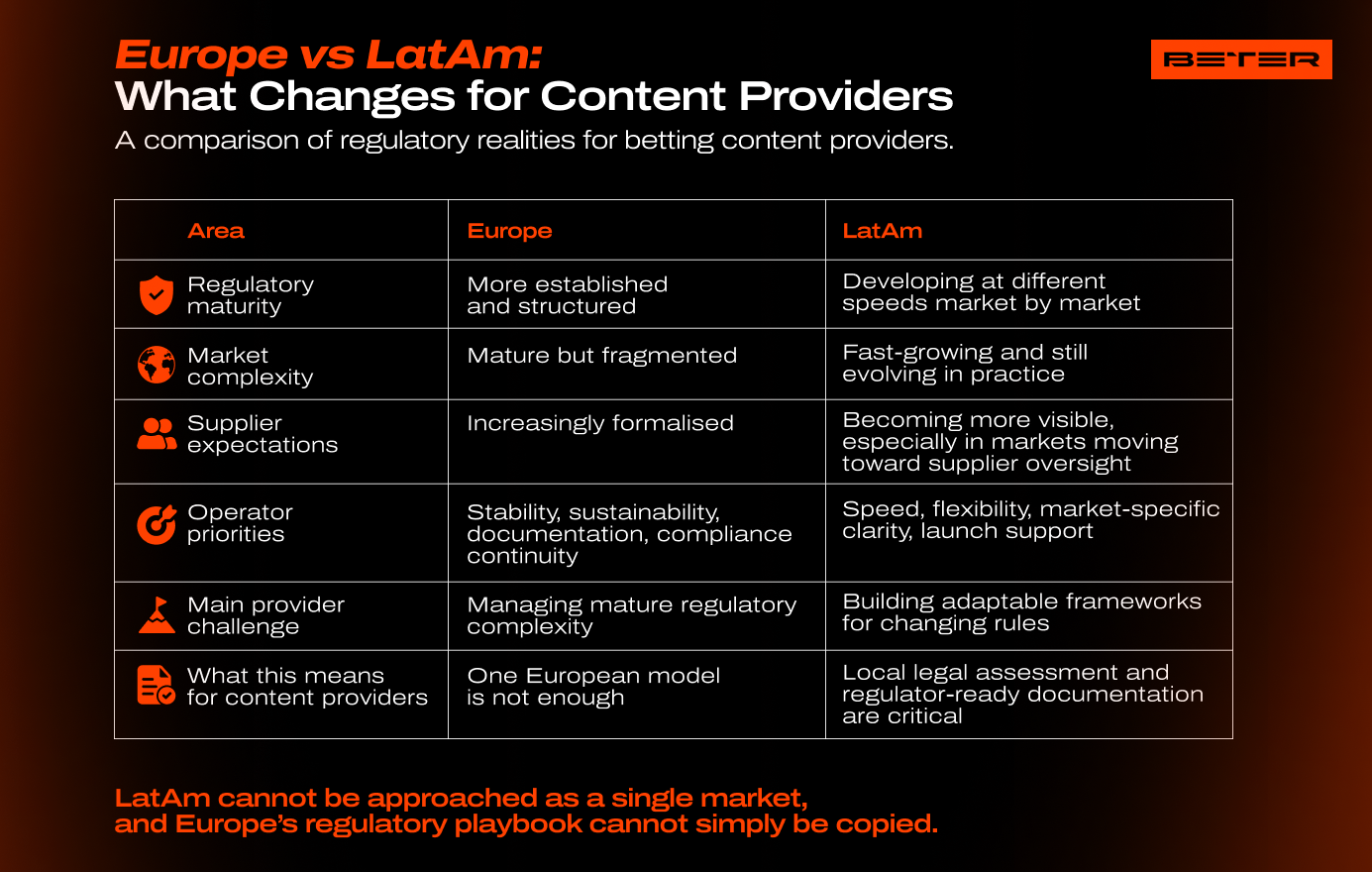
LatAm is a good example because the region is not one single regulatory environment. Colombia has a more established online gambling framework. Brazil is moving through a major regulatory transformation. Peru and Argentina have their own licensing and certification approaches. Other markets are developing at different speeds and with different levels of clarity.
For international operators, platforms, and suppliers, this means that a single legal template is not enough. A model that works in one market may not be sufficient in another. A provider that wants to support regulated growth in LatAm needs an adaptable legal framework, not a copy-paste market-entry approach.
Europe and the US offer useful regulatory experience, but their models cannot simply be exported. European markets are mature, highly regulated, and often fragmented, while the US has its own state-by-state regulatory complexity. LatAm brings a different challenge: fast commercial growth combined with regulatory frameworks that are still being tested, clarified, or expanded in practice. That creates a need for providers that can operate with both structure and flexibility.
Brazil signals a shift for B2B suppliers
Brazil is an important signal for the wider region. As the market becomes more regulated, the role of B2B suppliers becomes more visible. This changes the relationship between operators and content providers. A supplier can no longer assume that all compliance expectations sit only with the operator. In some cases, suppliers must be ready to explain their own systems, products, data flows, controls, and governance standards.
It means that content providers must think like regulated-market partners from the start. Not after a contract is signed. Not after a regulator asks a question. Not after an operator’s compliance team identifies a gap. The legal and product work needs to happen before market entry, before integration, and before scale.
For sportsbooks, this approach reduces friction. A regulator-ready provider can help shorten due diligence, reduce back-and-forth between legal and product teams, and give operators greater confidence when launching new content. For aggregators, it can also strengthen supplier onboarding by reducing uncertainty around product classification, documentation, integrity, and responsibilities.
There is a practical commercial point here: regulatory readiness protects speed.
In fast-moving markets, operators want to launch quickly. But speed without structure is risky. If the product is not clearly documented, if responsibilities are unclear, or if integrity controls cannot be demonstrated, the launch may slow down. A provider that has already prepared the legal and product foundation can help the operator move faster without increasing exposure.
High-frequency content needs post-launch governance
This is particularly relevant for fast-paced content because the product is built around continuity. It is not a one-off event or a short campaign. It is a live, recurring, high-volume content stream. That makes post-launch governance just as important as pre-launch approval.
Integrity is a central part of this. For fast-paced content, it is not enough to say that events are monitored. Operators and regulators need to understand how monitoring works, what standards apply, how suspicious activity is escalated, and what external validation supports the process.
At BETER, only 0.03% of more than 700,000 annual events were flagged as suspicious. BETER’s exclusive ESportsBattle tournaments have also received ESIC Gold Standard accreditation following an external audit. These are not only reputation markers. They are part of the evidence base that helps regulators, operators, aggregators, and compliance teams assess whether the content can be trusted in regulated environments.
What operators should ask before launch
Operators should therefore look beyond the commercial proposal and ask deeper questions before choosing a provider.
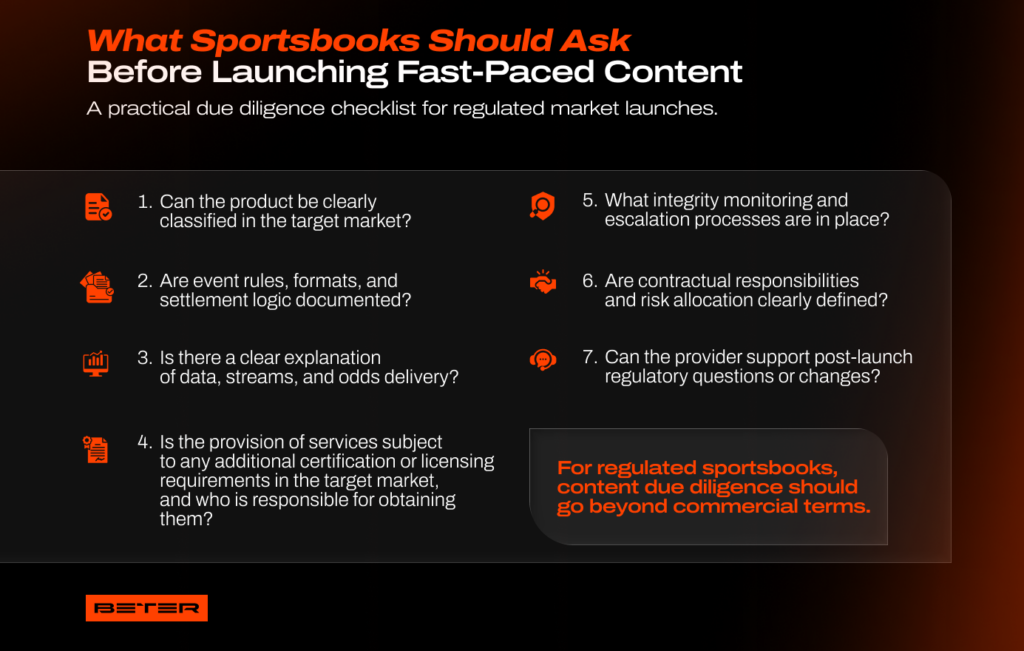
Can the provider explain how the product works from a regulatory perspective? Can it support a local legal assessment? Can it provide clear event rules and product documentation? Can it demonstrate integrity monitoring and fair play standards? Can it support contractual safeguards around data, streams, odds, responsibilities, and market-specific requirements? Can it respond if regulatory expectations change after launch?
These questions are becoming part of the buying decision.
At BETER, we see legal readiness as part of the product’s value. A content provider cannot support regulated growth only through commercial ambition. It needs the internal processes, documentation standards, integrity alignment, and legal expertise to make that growth sustainable.
This does not mean that every provider needs the same regulatory strategy. It means that every provider working with licensed operators should understand that compliance expectations are moving closer to the supplier side of the value chain.
The next stage of competition in LatAm
For LatAm, this is especially important. The region has the commercial momentum, the audience interest, and the operator demand. The next stage will be about which companies can scale responsibly within regulated frameworks.
The providers that will stand out are not simply those with the largest content portfolios. They will be those that can combine performance with legal certainty, integrity governance, and regulator-ready operations.
For sportsbooks and aggregators in LatAm, the choice of content partner should reflect that reality. Fast-paced content can create strong engagement. But in regulated markets, engagement only becomes long-term value when the product is built to withstand legal, regulatory, and operational scrutiny.
Originally published by Gaming Intelligence Español.