The 2026 World Cup presents a tremendous acquisition opportunity for online sportsbooks, but without a retention strategy, those bettors will have churned by August. This is due to downtime that creates an engagement gap operators often struggle to bridge.
I’m talking about 15-minute half time breaks, the hours between triple-header matches and the morning build-up to games. These are the gaps during which bettors drift to social media and other entertainment options.
Getting these players back is expensive – bringing a customer back to the sportsbook or betting app for the 8pm kick-off if they left after the 5pm match can cost up to 5x the initial CPA, according to various industry studies.
For operators, keeping bettors engaged during these downtime periods is mission-critical to maximizing the World Cup opportunity. High-frequency esports content, such as eFootball, isn’t just a way to fill these gaps; it offers a compelling, standalone betting experience, designed to meet the demand of next-gen bettors. With the psychology of the modern bettor shifting toward shorter attention spans and instant engagement, operators must rethink both content and experience to keep users active, whether between matches or long after the tournament ends.
Betting in the attention economy
The majority of sportsbooks were built for a traditional experience: players place a bet, wait 90 minutes (plus halftime and injury time), then collect.
But the modern bettor is different – influenced by high-frequency trading apps and short form video, they run on a much shorter dopamine loop. In an industry competing for “share of wallet”, operators are increasingly competing for a “share of attention” against non-gambling entertainment.
With traditional sports betting, this creates a dopamine “lull”. During a 15-minute half time or a two hour gap in between games, the betting intent is still high but the event availability is often zero.
Not only that, but our data from the EURO 2024 report shows that bettors crave outcome velocity – during major tournaments, “totals” markets account for 55% of eFootball volume as users seek markets that settle in minutes rather than hours.
Take our fast-paced eFootball matches, for example, one of the most popular disciplines in our exclusive ESportsBattle tournaments. These matches last approximately eight minutes and offer a range of betting markets that settle almost instantly.
It’s also important to factor in cognitive load. Between high-stakes World Cup matches, bettors often want low friction entertainment. eFootball fits the bill as it requires less analytical “work” than a 90-minute tactical battle, making it the perfect quick-hit experience between matches.
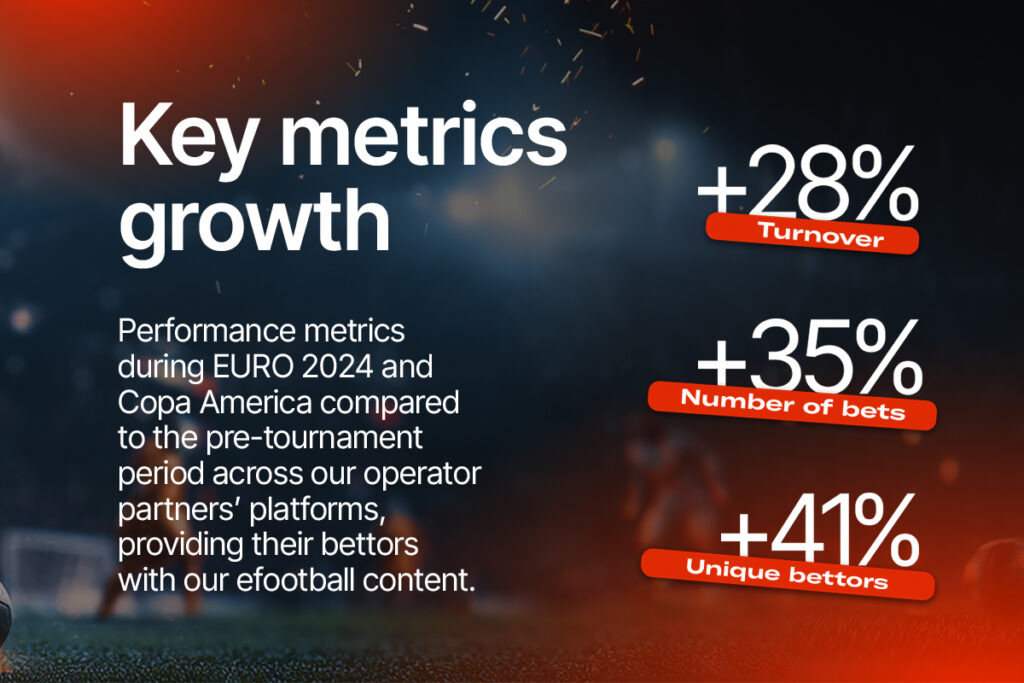 data from BETER`s EURO2024 report. Learn more at: https://worldcupboost.beter.co/
The architecture behind the “bridge” strategy:
This is why eFootball should not be treated as a standalone vertical, but rather as a natural extension of real-world football engagement. In practice, this means suppliers running bracket-aligned eFootball tournaments that mirror key World Cup matchups throughout the day.
For example, if England plays France at 8pm, suppliers can schedule England vs France eFootball matches in the morning, during half-time windows, and after the final whistle. This approach extends the betting window and keeps players engaged well beyond the live match itself.
The data backs this up: during Euro 2024, BETER observed a 23% spike in eFootball turnover in the 10pm-11pm window, proving that fans are looking for a ‘second half’ of entertainment the moment the live broadcast ends. Notably, turnover remained elevated for several hours afterward.
The most successful integrations don’t hide esports in a sub-menu, instead, they utilise contextual discovery, featuring the eFootball “next match” directly on the World Cup homepage during the content gaps.
The revenue impact beyond the spike:
The biggest risk operators face is the cliff edge, the massive drop in activity that comes once the final whistle blows. But data drive retention through products like eFootball focuses on flattening that curve.
For example, major tournaments have rest days between matches and especially things like the quarter finals and the semi-finals.
With this in mind, fast-paced content can keep bettors active on the sportsbook platform and retain a significant share of typical match-day turnover during rest days, compared to a near-total drop-off for operators without such offerings.
Ultimately, this leads to a much higher LTV from each player. By introducing a World Cup bettor to high-frequency esports, you are training them to use the sportsbook year round. Since eFootball runs 24/7/365, it solves the season churn problem that plagues the industry.
Fast-betting content often yields higher margins, too – our eFootball offering sits at around 7.5+%. This is due to the volume of bets placed in a short window – the more “cycles” per hour, the more theoretical hold for the operator.
Integration of fast-paced content isn’t just a retention play; it’s a growth engine. Across our partners during the last EURO 2024 championship, we saw unique eFootball bettor counts rise by 41% and overall turnover jump by 28%.
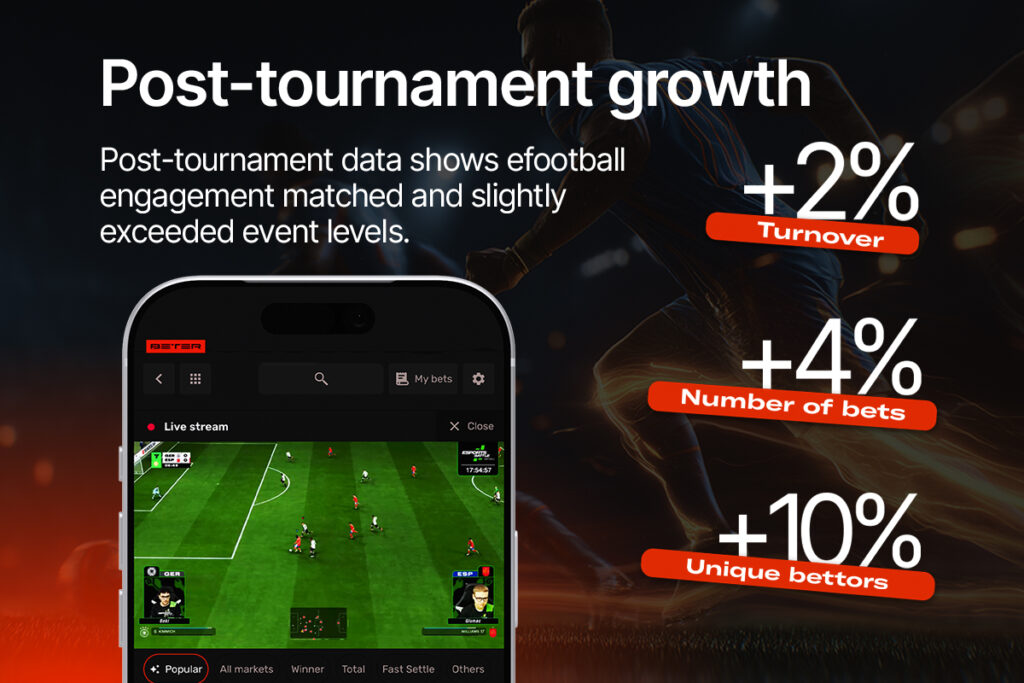
Our data also shows that eFootball engagement remained high after the tournament and even slightly surpassed in-tournament levels, with an additional +2% in turnover, +4% in bet volume, and +10% in unique bettors. The main driver was the period immediately following the final: with top-tier football concluded and domestic leagues still in the off-season, bettors shifted their attention to eFootball as the only continuous football experience available.
Beyond the final whistle:
The benefits of fast-betting content such as eFootball extend far beyond the World Cup itself. The tournament represents a peak engagement moment, giving operators the opportunity to scale proven mechanics and unlock long-term value.
If an operator can successfully “bridge” a bettor to eFootball during the World Cup, they have secured this attention and wallet for the quiet Mondays in November when there is no live football.
In a crowded market, operators that can provide a non-stop entertainment loop become the default app on a user’s homescreen, reducing the effectiveness of competitors’ bonuses and promo offers.
The ultimate winners of 2026 won’t be those with the biggest marketing budgets, it will be those with the most sophisticated understanding of user downtime and the content required to fill the gaps in offerings.
As we look toward North America, the question for operators isn’t if they can afford to fill the gap, but if they can afford to leave it open.
The article was originally published at The Bet Press